Gurdjieff International Review
A Passion for Understanding
Notes from an Orage Group, New York, 1927
by Frederick Schneider
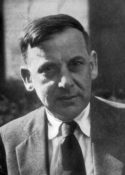
The material that follows is drawn from the notes and letters of Frederick Schneider (1883–1933), who was a student of A. R. Orage in New York in the late 1920’s. While Schneider’s notes overlap some of the material in C. S. Nott’s book Teachings of Gurdjieff and the C. Daly King book, The Oragian Version,1 they have the advantage of being a contemporaneous report of Gurdjieff’s teaching—as transmitted by Orage—by a student who makes no pretensions of great understanding, but is simply attempting to record what he has heard and seen. In addition, this material is from the period when Orage was editing an early version of Beelzebub’s Tales, and thus may provide insights into Orage’s understanding of the book.
An interesting aspect of this material is the light it sheds on the apparent differences between the “food diagram” outlined by Ouspensky in Chapter 9 of Fragments and the description of human digestion in Chapter 39 of Beelzebub’s Tales. Schneider’s notes outline what appears to be a third version of this symbol, with some differences from the other two. It portrays the thinking, feeling and instinctive “minds” as each having a plus and a minus part, and describes the movement of attention among these six “centers” with and without the effort of self-remembering. These differences raise in a concrete form the question of whether such discrepancies are a consequence of a too literal interpretation of the diverse external forms by which an “internal teaching” has been portrayed.2
As to the material’s authenticity, there are two questions to deal with. First is the question of whether the original manuscript is genuine. Mr. Schneider’s daughter clearly remembers meeting Mr. Gurdjieff in New York as a teenager, and also remembers the letters her father sent from the Prieuré. Some of these notes are copies of letters by Mr. Schneider to an unidentified cousin, others are his brief summaries of lectures, and some contain references to other students, as if they were sharing their notes. There is no doubt in my mind that the old and faded carbons I worked from were Mr. Schneider’s copies of his own notes, and that he was a member of one of Orage’s groups in 1927.
However there is a second and much more difficult question, and that is whether Mr. Schneider accurately recorded Mr. Orage’s lectures. On this matter, people must exercise their own judgment. “The proof of the pudding is in the eating.”3 In addition, one should remember that in the third series of his writings, Mr. Gurdjieff discusses his trip to New York in 1931 and his public renunciation of the form of the Work that Orage had presented to his New York students.
Schneider’s original notes are rough and unedited, necessitating extensive cutting and rearrangement. Approximately 50% of the material has been deleted to remove redundancies, personal notes, and hopelessly obscure fragments. In addition, a very small amount has been added to clarify indefinite pronouns and the like, although I have chosen to preserve, for the most part, the agrammatical immediacy of the originals.
We cannot remember ourselves because it is only with our mind we try. The other two centers have no interest in it, but they must change. For total change is possible only through emotional and instinctive centers. Yet those two centers must be changed. But they have no language. Yet mind alone is not a human being, any more than a driver alone is a whole equipage. The center of gravity of change is in the emotional and instinctive centers. But these are concerned only with the present. Mind looks ahead, but the desire to change must be in the emotional center, and the ability to change must be in our body. But it must learn their language. This is the work of self-observation.
The first advantage of self-remembering is that one makes fewer mistakes in life. To complete self-remembering three centers are necessary, and all must be artificially stimulated, the intellectual from the outside, the other two from the inside. Distinguish between sensation, emotion and thoughts. Thereafter say to each sensation, emotion and thought—remind me to remember you.
Human work is with three centers. Any other is sub-human. For this reason it is thousand times more precious to the human soul to scrub a floor consciously than to write 100 masterpieces unconsciously. Combined three-center work is impossible until each center has been taught to work by itself.
Freedom is the ultimate goal of all schools, consciously or unconsciously. There are two freedoms, the greater freedom—freedom from outside influences; the lesser freedom—freedom from inside influences. The two chief obstacles to the lesser freedom are self-pride and vanity (vanity is of the body, pride of accomplishment is of the mental or emotional centers.) Self-pride of the real kind begins with the work of “I.” He who has real self-pride is already half free.
Until man separates himself from himself, he can neither do anything for himself, nor be helped. We have two aims—to separate “I” from it, and thereafter to govern it unaided (freedom). An adult is one who seriously wishes to separate himself. Mind and essence live separate lives. Essence is always changing, with food, people, weather, etc. At present mind submits to serving this changing essence. Mind is governed by a devil (changing essence). Do not let your mind slave for your essence. The thinking center is Christian. The emotional body is pre-Christian; the body is pagan. Emotional center with body makes the devil, which the thinking center must learn to control.
| Thinking | Individuality |
| Feeling | Consciousness |
| Will | Sensation |
Observe: voice, movements, gestures, postures, facial expressions, sensations. Awareness without criticism. We are continually side-tracked from our intentions. Thousands of influences sidetrack us. Individuality would be shown as a straight line.
Unnaturally resist natural temptation to act in natural way. When attempting to observe oneself, don’t speculate, analyze, criticize; when something is seen, immediately become aware of something else—IMMEDIATELY.
There have been 9000 years of civilization, 8 or 10 civilizations. This civilization will die, making same error—not working in harmony with nature… Self-consciousness, being aware of body that has been presented to us. Have control of physical body. Aware that you have a body. Self-conscious, one is actually aware of others… We are not free, because we fear. Fear—absence of self-consciousness. We are not free to choose our body. What body would we have chosen? Couldn’t control conditions of birth. [Our education was] limited to conditioning. In school, we are subjected to forcible ignorance. At majority free? Not a thing we say, feel, hasn’t been conditioned. No freedom in us. Object of life to attain greater freedom.
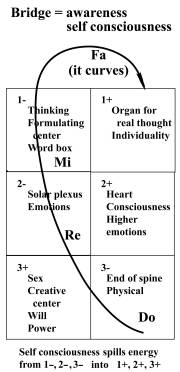
The object—to stop energy leaks. There is a means to create new energy, but why create new energy when you have not stopped the leaks? Stop the leaks first. Until you have, it would be like trying to hold water in a sieve. To review, a human being is made up of six centers:
1– (1 minus) Thinking, passive, formulating center, word box, forebrain;
1+ (1 plus) Real thinking, individuality, positive, organ of real thought, rear brain;
2– (2 minus) Emotional, passive, solar plexus;
2+ (2 plus) Consciousness, higher emotions, heart;
3– (3 minus) Physical, end of spine;
3+ (3 plus) Will, sex organs, creative center.
It is by awareness without criticism that you stop the leaks. When you observe, are aware, the excess energy of the three passive centers, 1–, 2–, 3–, that is, thinking, emotional, and physical, spills over into the other three centers: individuality, consciousness and will. Leaks of 1–, 2–, 3– are respectively, day-dreaming, emotional anxiety, and physical tension.
“Nothing is understood until a year after these lectures.” It takes that long to get the real significance. That is why Orage repeats so much of former lectures. Impressions automatically received, response necessarily automatic. Again, you can’t make a conscious response [to an impression] unconsciously received. Centers 1–, 2–, 3– are subject to education. We don’t invent English—we speak English. We don’t invent emotions—we act emotions. We don’t invent gestures, postures, movements—we copy them. You can tell a foreigner, westerner, etc. from his speech, actions, etc. Self-observation for one hour a day will add one month (not exaggerated) to your real life. Most people like day-dreaming, sad emotions—they keep sad letters, they like the sensation of dying. Observe and soon you will find you can do something. Centers 1–, 2–, 3– cannot do…
Consider air as menu. Can select and take from it what we want. Can stay in a stuffy room 6 hours and feel fine. It’s what we absorb in breathing [that matters]. Air is one kind of food. Then there is ordinary food, meat, vegetables, etc. Then there are food impressions. Go into room. What you see, the kind of impressions, will determine kind of thoughts you will be able to exercise. Thinking food = impressions, emotional food = air, physical food = meat, vegetables, etc. Events initiated in one direction end up in opposite direction. WE ARE WARNED AGAINST SELF-IMPROVEMENT!!!!!!!!!!
Pythias. Last Tuesday another Orage lecture. I want to write about it for my own benefit, to see what I have absorbed and retained. So am making a carbon to send to you. I may write up subsequent lectures. Am not so good at it, and this may not interest you. If so, let me know and I will save two cents, and wear and tear on a carbon sheet.
Nature is a factory turning out machines. After years and years of turning out lower forms of vegetable matter and living things, it succeeded in manufacturing reptiles. Later it added mammals to its accomplishments, and finally, human beings, of which it is turning out millions a year. Each is an improvement over the former. Humans are turned out with three springs, intellectual, emotional, physical. Mammals, two springs; reptiles, one spring. In human beings, the three springs are wound up at birth according to heredity. All not the same. A person may be born with one spring wound up to last two hundred years; her second spring eighteen years; third, ninety years. The respective springs run down according to original intensity of winding, and to extent they are used… If born with springs wound all three the same—then athletic person will have her physical spring unwind first; artist, musicians, poets, etc., have their emotional spring run down first; scientists, etc., have their intellectual spring run down first and so on. But there is such a thing as economizing. A spring wound not so tight at birth may outlast the other springs by economizing. The idea of these lectures is to learn how to economize and not have your springs run down…
Man is stupid to think he is wise because he has read. Consider the story of an ass who finds himself on a prairie with all the grass burned off. Says he, “I must be fat to have eaten all the grass.” What the world is we do not know and cannot know. What others tell us means nothing. They have seen it with different thoughts, emotions, sensations than ours. What impresses them may not impress you and visa versa.
Yours clear as mud, Damon.
Pythias. Most people never take these lectures seriously. If studying a language, or mathematics with a tutor, with daily lessons that must be learned, one would spend time on them, but when left to one’s own initiative, effort is absent.
Taking up the six observations again. Gestures often offset speech, give wrong impressions of what you say. We give ourselves away with our hands while saying something different. Gestures responsible for wrong impressions conveyed. Examination of gestures necessary for intelligent life. Watch yourself, and make list of all your various gestures for one week. Then you will have a complete vocabulary of your gestures. Note similar gestures in someone else and know what they mean.
Regarding postures: Every race has specific postures. We don’t sit like Indians. We sit like Americans. See man standing before a fire. You can tell at once whether he is American or English. Note a man sitting. Can tell where educated, even from what college attended. Characteristic postures change with emotions. The more one leans back in a chair, the more the person seems at home. Posture precedes impression one wishes to make.
Regarding voice: One may have wonderful vocabulary, but tone of voice would queer it. One would believe opposite of what said if said in certain tone of voice. One would say, “He did not mean that.” Sincere tones are believed. Know your sincere tones and be able to convey what you mean, your object.
Facial expressions are an elaborate language. “Did you see how he looked?” A single facial expression can be considered a gesture. A wink might mean, “meet you outside,” etc. Make serious effort to write down tones of voice, gestures, postures, facial expressions, this week and get complete vocabulary. (The other two, movements and sensations, were not mentioned.)
Need not write observations down at the time, later from memory will do. Lie in wait for opportunity to note voice, postures, gestures, facial expressions, under extreme conditions. Record moments of jealousy, anger, surprise, disappointment, etc.
Three Classes of Self-Observation:
Impressions are never effaced, memory never forgotten. Never substitute intentional thought for day-dreaming. Your parents wanted you to become mathematician. You study, become specialist. Your physical center becomes associated with images of mathematics. Same regarding business or farming, etc. If you were brought up in an irritable family your emotional center becomes filled with irritable images and you become irritable. Amicable associations, amicable…
A monkey can move a muscle in the palm of his hand, a horse can shake the skin of his neck to chase flies, a dog can make his hair stand on end. These are muscles of which we have lost control. Our centers—individuality, consciousness and will—have never been used physiologically. Heart is the conscious center, sensitivity. Will is not resolution or wish, it is the ability to make something out of nothing. Rearrangement of ideas is nothing. You can use muscle never before used only through act of will.
Long ago it was decided to make man better, they inaugurated education, censorship, sanitation, etc. Later they added religion. All that did not make man better. Observe behavior continuously, simultaneously, that is what will make man better. You can’t observe without will. Can’t observe self without observing something. Observe thought, emotion, physical. As long as you water root, plant will grow. Practice non-habitual responses. Practice self-observation, participation, experimentation. Try this, write verse of poem, while you are reciting verse of another poem and memorize strange verse repeated to you at the same time. Try this now, again in month, and note improvement.
Guess this will hold you for a while, Damon.
We think, feel, and are same if do same things in same way. Never do things in same routine. Impossible to have new thought if you do same things in same way. Do something constantly new. To hear new ideas without applying them, is like throwing seeds on the pavement. Do them. Change for the sake of change, not criticism. Try for one week to write with left hand. If confused and can’t think, do something unusual, stand on your head if you can’t think of anything else, do something out of the ordinary, can then think better. Study yourself, such wonderful experience…
We ingest three kinds of food: Regular food for the physical center (the body), Air for the emotional center, Impressions for the thinking center.
We know little about air and nothing about impressions. We prefer fresh vegetables because certain elements from nature are lost in canning. Good food, better physical health. To know how to control emotional and thought food infinitely better for moral culture than legislation. Mastication, diets, a foolish craze. In this lecture room there are as many varieties of air as there are foods listed on the menu in a good restaurant. The air need not be changed. All elements in this room necessary for completion of emotional life. The problem is to be able to abstract from the air that which we need. For a faulty digestion the best food is poison. Same air for all of us in here. Some are depressed, some are emotionally exhilarated. Some people have power to assimilate air better than others. (However, artificial exercises in breathing are harmful; they bring other organs in body out of rhythm.)
Our body is absorbing impressions at the rate of 10,000 per second. Light, sound, touch, produce chemical changes in us. I look at an object, hear a sound, feel a touch, any one of which has created a permanent change in me. These are impressions.
Food will not digest without air. Emotions control breathing. Impressions control emotions. Our aim therefore should be to affect impressions. Watch, be aware, always, continuously, rest takes care of itself. Breathe how you like, eat what you want. Try to resist monotony with all your might. You need not make impressions—travel, scenery, works of art in home. The poorest home has enough [material] in it to get cheerful impressions. Make them. “Bad impressions” can be made good and visa versa.
Nine-tenths of thoughts are mechanical associations. A peasant’s thoughts contain no words, but have understanding. Understanding a blending of intellect and intuition.
If you were about to die, ask what moments have I really lived? What can we do to get thrills? What can we do to make “I” pass from the mechanical thinking center (1–) to the individuality—the real thought center (1+)? We can spend a fortune, and a lifetime, seeking for thrills and never get them. Yet some poor people can. We all have some special emotion or thrill that came to us once in our lifetime through accident. How can we get those thrills other than by accident? Be aware. Be aware for one week of your voice, next week many a thrill.
Control of emotions. Life subject to words we use, auto-suggestion. All our acts under suggestion. Always counteract suggestion. Only respond to facts. Get acquainted with yourself as you would another person. Be curious of yourself. No two human beings alike, as there are no snow crystals alike. If a new specimen of animal were found, scientists would study it and soon know all about it. Get busy and study and get to know about your unknown self. Ignore your own thoughts and feelings, your likes and dislikes. Start plotting behavior. Look in mirror until you have forgotten it’s you. What shall I think of “it” when I meet it? If you look long enough you will get a moment of non-identification. Our physiology is like a hand of cards, it’s how you play it.
“I” vs. it. It should be our servant, but is now our master. Review our physical progress from germ. The “I” germ grows by knowing more about our organism. Every impression is food to “I,” “I” grows. We can remember but cannot recall. Study pictorial record of past, not acts; it must be the image. Children say, “Billy does so and so” we discourage them, they must say “I do.” Wrong! Realistically try to recall phases you passed through to become what you are today. Speak of self as “it,” not afraid to criticize… Spend time reviewing one’s past pictorially, as from outside. Imagination is an attempted recollection of facts, a faculty that is developed by attempting to do something.
Secret of economizing—never act in one center alone. Don’t only read—picture. Don’t only think—walk. Rosary—not for prayer—to give hands something to do. Do three things at once to economize—this is the sovereign cult. Lie down, think yourself dead—relax, then clutch one hand, everything else limp. Do same stiffening neck, etc., realize what it means to employ only those muscles necessary.
Make note of all emotional experiences. Body slave of emotions, fear, jealousy. Unconscious thoughts go on continually, even when asleep. Emotions respond when struck by images of conditioned or unconditioned thoughts… Thought has no effect on body, acts only through emotional system. Two kinds of images, current and recollected. Emotions respond to images. You can revive images—pleasant, unpleasant, recover moods… From depths of despair to height of happiness by changing image. If you can control image you can control emotion, therefore you can control body, behavior. Can’t induce sleep by thought. Don’t think of tomorrow as being tired, rings under eyes, etc. Think of tomorrow as being bright as a lark, feeling fine, insomnia leaves. Sickness a theory.
Associate impressions with state we wish to induce. Too much sleep like too much food. Sleepless night won’t hurt me. Awareness makes power to make Impressions. Makes Will. Will helps Impressions. Impressions control Emotions. Emotions control behavior. Wishes desired are emotions.
Body our given medium for contact with given world… We owe body to parents and education. Everything a gift, no choice. The use you can make of body is what counts. Begin to equip ourselves to be able to try to become human.
Sensitiveness. Pride hurt often incurable. Can stand criticism if we consider “I” has body, we are not responsible for body as is. Anything can happen to body, “I” is not affected.
Don’t mind draft, just air traveling at faster rate. Anger, emotion, wasted energy. Suppress it. Refuse to think of cause. Increases understanding. If angry, laugh. Always do opposite of habitual channels. Emotional understanding. A mechanically expressed emotion of love is a waste. Don’t stroke hair, give money. Positive emotion must be trained. Negative emotion must be diverted. Emotions are struck by images. Change images. Change things. Climb mountain, get perspective, a broader view. See from different viewpoint. Pick up a repulsive animal, [create a] pleasant image. Don’t give up because first effort fails.
“Impressions automatically received, response necessarily automatic.” Orage pays little attention to questions asked which are derived at time of his lecturing. Wants questions originated from efforts and observations during week. Again, beware. Do not try to improve yourself!!! Just be aware.
Wonderful exercise: Recall, picture your body at all ages from as far back as possible: 3, 4, 5, years on. Try. Impossible at first. Not what your thoughts were, but how you looked.
It is impossible for anyone to create an interest within you that does not exist. Interest continues to degree we are interested. Cultivate curiosity regarding self-understanding. If you have no interest in your body, find what you are interested in. Life consists of gratification of interests. We call this the growing end of being.
Every word has special meaning to everyone. Let us set up a language we all understand. We think with front of head. Back not ordinarily used. Three-fifths of brain never used. We never forget a heart emotion, these higher emotions can be developed.
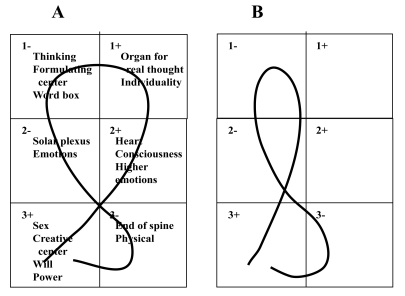
Life starts with sex center (3+), curve passes through 3– (physical), 2– (solar plexus, emotions), and 1– (automatic thinking). “B” is called the fatal curve in life. At the age of 30 to 40, most people just think of food and sex, taking Curve B. On the descending leg, Curve A passes through 1+ (real thought, individuality), 2+ (consciousness, higher emotions), and 3+ (will power). Begin now, in this moment, to search for the possibility of Curve A. Be aware of voice, movements, postures, gestures, facial expressions, sensations. Eventually you will stop doing things automatically, like a machine. For one week be aware of one thing only. Start with the voice. (I tried it so earnestly and was only able to be aware a few times all week. It’s so hard. F.D.S.)
The senses: Tactile objects… Small planets of senses which move around central sun of visualization. Things heard… There are beings who have but one sense—who only hear or see or touch or taste and so on. For Seraphim the whole world exists for stimulus of sense of hearing. Visualization should be felt in back of head—any other place means mixing up of senses. Memory of the nose… Review past life by experiences through the nose. Taste… Taste buds are most highly developed of all senses, next to sex cells, and the most intelligent. “The most nearly human of the cells.” Aesthetic and moral tastes are based on our physical experiences of taste. Motor sensations… Thermal sensations… Kinesthetic… Eventually write autobiography of each sense.
I have three bodies: With one I move. With one I feel. With one I think. This work at present is work of a mental nature corresponding to physical movements. Psychological exercises belong to the second phase of development according to the plan adopted by the Institute. The third phase will be the emotional, which will be approached through music. Are these exercises designed to develop our mental body? Are these exercises supposed to make us think more and more and better and better, making for a greater agility of our mind? Of our three bodies only the physical is complete.
Man is a being whose sword is bent into a cycle of interrogation. One can understand the words but not the sense, verbal understanding. Verbal understanding, formal understanding, and objective understanding are three planes, all infinite. Pass from one form to another by leap, no tie between.
Oyster exists for pearl he makes, pearl is his objective understanding. What do we live for? Objective understanding. Effort is pain, voluntary effort most painful. Man is defined as quantity and quality of effort expended. Conscious labor, self-observation. Have a passion for objective emotional, instinctive, intellectual understanding. Three forms of mind: mechanical, non-mechanical or objective, emotional or intuition.
| I | wish | to remember | myself. |
| I | am | a | soul. |
| I | have | a | body. |
Modern psychology—travelers without map. Gurdjieff method—map without travelers. Understanding a blend of intellect and intuition… Nature hostile to development of man. One out of million normal… Ninety percent of thoughts are mechanical associations. Man a being to encounter, create, and overcome difficulties. Contrast with peace and rest. Overcoming great difficulties human virtue. Never do as others do, necessitates originality, do things own way. Man is in essence a passion for attaining reasonable understanding of the aim of existence—what life is all about. Always jot down pondering thoughts… Nature cannot develop “I”, only I can.
How develop “I”? Self-observation, voluntary suffering, consistency in making efforts, conscious labor, labor for sake of consciousness. A “normal” human being spends half his time pondering… If pondering needs practice, when are you going to begin? Gurdjieff system a manual of normal psychology.
What is intuition? An intuition is an experience when two centers happen to coincide at same moment. I experience two centers and register it as fact.
The objective universe is the work of a conscious creator, consciously maintained, for a conscious purpose. Objective universe, perpetual motion machine by master engineer. This differs from a machine only in degree… Beelzebub’s perpetual motion machine is an arrangement for replacement of worn-out parts. God intervenes from time to time to prevent wearing out. Needs constant watchfulness. An expanding universe results in greater need for agents as helpers. God enlists as agents certain three-centered beings.
Sun absolute—intellectual reason, mental soul body. Any sun—emotional, astral body. Any planet—instinctive, planetary body. What do I regard as characteristics of a normal being, if I had the creation of humankind in my power? Ask questions not to be answered. Questions more fruitful than answers. Answers you forget, questions not. Try intelligently to have a passion to understand and a will to overcome difficulties. Regard daily problems as exercises. Be happy only when encountering, creating, and overcoming difficulties. A normal being will not be fidgety when overcoming difficulties, when he is uncomfortable, thirsty, hungry, etc.
Never do as others do, not necessarily opposite—different. Our cosmology is an expression of one’s chief feature. Daily review, always do it forward, at the end of the day:
I have an “I”, is a lie. Act as if you love your enemies, you will love them. Act as if you have an “I”, you’ll become the possessor of one. Act as if, and it will become a fact. It will become true to you. Take away heredity and sociology and what is left of me? We have had nothing to say about “I”… Move from, “I have a body,” to, “I have the use of a body.” Hope for freedom of conditioned body. You are consciously repairing the car. Tell your friends the car will eventually run smoothly. Conceal change is taking place.
We are responsible for all manifestations except under death pains. My horse shot under me, if horse still alive, responsible. No less responsible if decrepit. Five minutes conscious energy discharges debt. Conscious labor pays debt of whole life-time… Observation intensifies emotion—welcome emotion. Effort, friction, fire, energy.
Creation begun, will never end. Objective universe is the work of a conscious creator, consciously maintained to a conscious end—to what purpose? Sum of normal functions: eat, sleep, feel, think, etc., passion to understand not possible without these. Impairing one normal function upsets reason. General duty fulfillment is object for which we were created… We have three brains which are made to use.
Moon needs vibrations from earth, special vibrations. Effort produces vibrations, ASKOKIN. Late war produced vibrations, who wanted it? Moon. How do we persuade people normally comfortable to go to war, and suffer? Can’t persuade people or nations, must be driven mad, poison the atmosphere with propaganda. Poor moon was surfeited. Two sufferings, voluntary, involuntary; former requires will power… You cannot escape suffering, therefore do it voluntarily, consciously.
We are in a trance. Susceptible. Play Star-Spangled-Banner, everybody rises, suggestibility, 99% of time in a trance, under suggestion of words and phrases. We are doped continuously in state of suggestibility. No active pondering in human race. Not more than two score on earth who ponder. Dare not ponder for fear of coming to disagreeable conclusion. Distasteful to our comfort. Better to suppress consciousness before it suggests something disagreeable to be done.
How dare you have caviar if you have not done a day’s work, even if the rest of the world goes hungry? Self-love. You can have all the luxuries provided you have done your duty. One hour’s pondering entitles you to caviar. Live in state of effort, days should not be long enough. To ponder and be aware, self-observation, takes no time. Do it in current moment. Human understanding product only of voluntary suffering and conscious labor. Result, modern beings do nothing. Everything is done through them. Books, entertainment, all food for Kundabuffer, unless consciously done, which is never.
Time is a process which cannot be sensed, felt, or understood, and cannot be understood by any faculty of the mind. Time is ability to experience. Why do dreams come to an end? What brings them to an end? Organism certain potentiality of experience. Time relative to sensibility. Time is sum of my experiences on this planet. Time is the “I” of I’s. Time ordinarily lived—passing time till death. Can only wake up through dreaming of three centers.
Sun has no heat, no light—emanations. Success = light = understanding. Unsuccessful = heat = failure. Heat is failed light. Cold brain—light. Warm heart—heat. OKIDANOC in air very substance we call light. Positive electricity—cerebral brain. Negative electricity—spinal body. Neutral electricity—visceral solar plexus. When we can produce neutral electricity we can make people.
Three brains, two only have roots. Have not developed like planetary body. Only three-centered beings can consciously create these second bodies. Nature, natural evolution, cannot do it. OKIDANOC limited, electricity used mechanically uses up the supply. Artificial light and heat for use of planetary body, think and feel less and less normally… Potential vs. actuality. Life potential of experiences. “I” determines actualization. We never lose being… “I” can decide to make effort. Nothing in my body can make me.
Life created according to degree of reason. Beings graded according to degree of reason. Standard of weight impartial, a pound is a pound, gold or lead. Standard of reason impartial, sum of normal functions.
The whole universe exists as physical body for sake of Sun Absolute. “I” is to our body as God is to universe. A life lived for sake of understanding, very thrilling. My body exists that I may understand. Our cells have God also. They discuss their place, their service to “I,” as we do to God. Our cells aspire to become highest part of highest brain. Human beings aspire to become highest part of God. Sun Absolute the soul body of God. All other suns, astral body of God. Planets the physical body of God.
PRANA is the blood of our nervous system, life of astral body. Regular blood, life of planetary body. Reincarnation can occur only to those beings who have become individual, whose soul has become conscious, the seed of conception of soul. No escape from incarnation… We have essence not crystallized, not distinguishable. Many years hence a being may have the life particles of each of us here present. Kundabuffer ceases to be active at birth of soul. Right thinking, conduct, sleep, etc.—eight in all—Kundabuffer gradually atrophies. The soul when conceived may become gradually developed.
What is meaning of life, for what do we strive, are we seeking? Same as universe. Search in itself, part of life even if nothing found.
Human being one in whom the three centers are active. In our life after 30 to 40 years, one center runs down, period of leaning is over… Extraordinary gifts do not make an extraordinary person. Extraordinary gifts go to people’s heads. Take an ordinary attitude toward substandard or extraordinary gifts. You are not responsible for them—why the pride? A normal human being is one whose passion for understanding is conscious… Stretching our mind, pondering, makes daily tasks easier.
Ashiata Shiemash’s problem was to produce substantial and permanent change in the human race. Here was a reformer who set out to make a change not in one place, but in the entire character of the whole human species. How would you proceed to bring about a fundamental change of this kind? Ashiata assumed that our present conceptions are limited, so he entered upon a series of exercises to obtain impartial intellection. He prepared himself to be impartial. He Prepared.
The human race had gone too far in subjectivity to respond to any appeal to hope, faith or love. It was impossible to have any understanding of these things. So he decided not to build his doctrine on any of these foundations. He founded it on objective conscience—defined as the voice of God—the representative of God in essence. In certain circumstances this objective conscience might be brought into being, and if it becomes articulate in an individual, that person becomes aware of his genuine duty—from being a slave, he becomes a son of God. Ashiata began by taking a certain number of people and giving them certain teachings and exercises—self-observation, participation, and experimentation. First result of this is unfolding of objective conscience, realization of duty, one’s place in the universe. We are here given formulations of genuine duty laid upon any individual with an awakened objective conscience. We are bound to take them in a subjective way.
Satisfaction of the planetary body. “Satisfaction” meaning fulfillment of needs, obligation to keep body in state of lean health, so that it should be pliable, adaptable, and uncomplaining, without indulging it. This means that a fat man, or man who indulges in anything is really immoral. Don’t indulge the body, don’t deny it. So this directive implies health. This refers to planetary body only. Since our range of life depends upon our physical range, body is our only means of life.
To improve one’s being. What is the meaning of being? A human body is for being. Being cannot be defined in terms of understanding, or of physical being. It’s not what we know; it’s what we are in ourselves. Ponder what is being, not in understanding, but in ourselves. For instance, have you any fear? Do you feel yourself manly or womanly enough to take chances? Have you the strength inside yourself to meet difficulties, can you be counted upon in an emergency? This state of being, being as the very essence of ourselves, is the only thing that ever grows in ourselves, and it is dependent upon the state of our planetary body. Some people, no matter how little they seem to accomplish in worldly sense, have some strength inside themselves.
It becomes important to realize what we mean by being—to understand what sort of a being I have. Do I feel some internal strength in spite of my external stupidity? There is one method alone for improvement of being—Being Effort. You are aware when you have done something that has required an effort of your being. Review each day. The moment of your maximum effort—the moment when you have done something for no other reason than the effort involved. Being efforts must be gratuitous—reward being the feeling of strength. We are in a Gymnasium, where maximum daily effort is required—exert yourself a little beyond what you feel disposed to do. Observe how much more man or woman you feel to be after such effort. This should be called the attainment of strength. Health, strength, the aims of objective morality.
The aim always to know more and more of the world and the laws of its creation and maintenance. This is the formal aim of philosophy; the understanding of the universe. It’s not to be thought that philosophy is the privilege of the few. It is one of the normal activities of a human being—the un-philosophic human being is not normal. A specific part of each day should be spent pondering about the meaning of existence, the understanding of human behavior, questioning our experience. You need not seek new circumstances, just question the meaning of what is taking place, in ordinary situations. We should be so inquiring in all circumstances. We should call this understanding. Preoccupation with meaning of everything that happens will stretch your capacity to understand, remember, think, observe, attend, etc. You may discover that your ignorance increases, that you realize how completely ignorant you are. Socrates said that he was the most ignorant man alive. The difference between knowledge and ignorance is the difference between knowledge and wisdom; it takes knowledge to realize ignorance.
“I” can never be objectified. Observe yourself. Observe your emotions, observe your mind. Veil after veil will lift, veil after veil will remain. The more you know, the more you will realize you don’t know. This also implies vice versa. The exercise of observing concrete birth, life and death on this planet is objective. We breathe in, some one is born. We breathe out, some one dies. This is the breathing of the planet. This will put you in a formulating state in regard to many other things. If you take impossible mental tasks like this, you will find as by-products many other things.
To pay one’s debt in order to be free to serve—Duty. Duty may be said to be a recognition of the performance of justice. We are all parasites. The cost of our being alive, nature has supplied. Relative to primitive man we are blessed by a birthright of a healthy body and favorable circumstances. But most of us do absolutely nothing to repay all this. Duty would contain the recognition of services rendered, and the obligation to repay them. How dare you squander the labor of others, making no corresponding return for keeping you alive? It would be moral to ration your expenditure according to your earned income.
Service. Helping others to serve individually. Really helping them to become independent, individual, healthy, strong. On the contrary, we usually cater to Kundabuffer in others at the expense of their possible development, by gratifying instead of satisfying, by catering to them instead of aiding. Only he who has himself performed certain things has any right to demand them of others. The only service you can render people is the service of aiding them to perform their objective duties.
Again, the reason of a being is the sum of his or her normal functions. A [normal] man or woman is one who actively discharges these functions in which the service of others is included. No questions—just duty. Passion—ponder the word. It is the intensification of a craze.
Leaves vs. Seed. Leaves fall, rot, and become manure for the tree’s future growth. In this way they recur. They are not a dead loss. Seed is a dead loss to the tree. Seeds do not recur. They go on. PRANA is the leaf. We are all recurrent leaves, with the possibility of becoming non-recurring, or reincarnating seeds.
It’s not too late to send in the ten questions, he wants them before he leaves on the Mauretania Dec. 30. First resumed meeting with Daly King, Monday, Jan. 9th, same place. Tuesdays—reading or book. First resumption of dancing Jan 6th… For such people as have realized their mechanicality, the rules of objective morality begin to be applicable. With this separation I begin to be awake…
Films are wound in us up to the age of adolescence. We are not living now. We are only watching unfold the potentialities which were wound up in us before adolescence. The character of an experience is determined by the character of these seven unwinding films. It’s true also that accidents occur. A spool wound up, may be dropped by fate. Then occurs a rapid unwinding. Individual then cannot again experience within the limits of that spool.
This brings us to the perils of civilization, as distinguished from accident. About accident we have nothing to say. But as to perils of civilization there is a specific warning against premature unwinding of any one of these spools. Each of us has a fixed capacity for thought. Thanks to an environment we may find ourselves reading a lot, etc. Thus our ability to think will be prematurely wasted. We shall be spun off without having actively done anything. Same thing will happen emotionally. Due to association with artists, by participation with emotion of others we lose ability to taste emotionally. Thirdly, under name of sport, many prematurely age their bodies. Any of these conditions may have been detrimental to one of your spools. We can never recover the fine rapture that preceded adolescence. Once run down the spool is down forever. If this is so, the possibility for normal development is gone forever.
Specific effort against this is—never to abandon one’s self to the associations of one center only. Never allow one’s self to become a specialist in one center. Aim always at a balanced ratio. Society is a devil. It’s an unconscious conspiracy for the creation of monsters, who shall be all intellectual center, all emotional center, or all instinctive center, called genius. Leonardo da Vinci was one of the greatest because he insisted upon being balanced thinker, artist, and practical man. Don’t allow children to specialize.
There is another effective method. This is the method of attempting to become self-conscious. It’s impossible with continued effort at observation to become specialized. It does not mean you can’t excel at one thing, it does mean that you can’t become identified. Try to be aware of seven-fold physiological manifestation, so you’ll never be a victim of tragic society, or of tragic accident. Tragic accident cannot affect you if you are observing yourself.
That brings us back to the definition of final aim or goal. Man is by essence a passion for understanding. This is the master magic current. Positive magnetic pole is in cerebral system. When currents are passing from cerebral to spinal, all is right with us. Vice versa all is wrong. We are crucified like Peter, because we are living head downwards. Some beings have their axis properly electrified, if they have increasing passion for understanding. Why is this so? Because the organism, man, was created for the purpose of creating a soul. A soul is a being capable of understanding the meaning and aim of existence. Amongst us, through this interest, we may fall under the influence of a new suggestion. So we may develop a normal interest.
This completes Ashiata.
Try while Orage is away, to rewrite the book in your own terms. Try to see how it compares with Behaviorism, Ethics, etc. See if you will become increasingly aware of ignorance, which is the essence of wisdom. Let us take a vow, a New Year’s vow, now, something along the line of what you want to do and can do. Have it done when Orage returns.
Vow is made to the Sun. Inclinations go toward the moon. Convert lunar momentum into solar impetus. It should involve profit, pleasure, and understanding. Resolve to finish something in the following two months. It must be vow that is conditional upon yourself only. It must involve no one else’s cooperation. It must be personally accomplishable. So you cannot slide out of an admission of failure by attributing it to others. If you do not keep your vow, all of us can neglect you in the future, none of us will ever believe a promise of yours again. It’s an excellent test—if you fail in a test of this kind … to find that particular vanity in yourself which made you believe you were a person of your word. It’s because of that we have no free will with which we can make a vow. It’s because we know that we are asleep that we are about to wake up. Why, as a group, do we make so little progress? Because as individuals we do so little.
If each of us made a vow and kept it, you would see how much understanding of the book we would have. If you make a conscious effort of this kind, you get back in compound interest all that you have invested. This vow will be the first example of a being effort consciously made. Try to foresee the external circumstances and not to take too difficult a vow. Stanley vowed to write 50,000 words on a book. Riordon to write 6 stories. Ils to write one book. Gertrude to earn $500 above maintenance expense. Orage urges all to make money—meaning I think, at something other than your profession…
I wish you all more than a happy New Year—just happiness is not enough—and more than a prosperous one. So simple a thing as the keeping of this vow will give you a working pattern of your own psyche.
“Ashiata founded his doctrine on objective conscience, defined as the voice of God, the representative of God in essence.”
I always revolted against the very mention of God and religion. Am I changing? I am. Am getting a different conception of God and religion. I do not believe in heaven and hell, and that going to church and praying and living a good life will lead you to heaven and the other life to hell. Pondering does bring forth questions. Why are we here? Where did we come from? Where do we go? Working on Gurdjieff’s method brings a glimmer of light. Self-observation, participation, experimentation, awareness, actually does improve you (so far noticeable only to myself.) You get flashes of light never before experienced. If the infinitesimal amount of time and effort I have expended on the method shows a result to me, what would years of extreme effort accomplish? What would generations of such effort accomplish? Is it out of the question to believe that originally man was a conscious being and that we have slumped into the mechanical beings that we are today? How can we grade the extent of the intellectual, emotional, and physical capacity that the early conscious beings had? No more than we can conceive the magnitude of the universe. Why then is it impossible for man to have been so developed in the three centers that he was able to do what we now call impossible? God is the universe. Man may have understood so much about the universe, or certain men may have, that they were said to have communication with God. Or be the son of God.
I cannot see a logical reason to believe that we were put on this planet to lead a certain definite kind of life, such as, to encounter, create and overcome difficulties. But I do know that to encounter, create, and overcome difficulties does create energy, and makes you feel better in every way. I do know that spending without earning, living without helping others, seeking only entertainment, leading an effortless existence, makes you feel like hell.
1 King, C. Daly. The Oragian Version, New York: Privately printed limited edition of 100 copies, 1951, 289p.
2 “They do not consider that at that period ‘being-mentation’ among the beings of this planet was still nearer to that normal mentation, which in general is proper to be present among three-brained beings, and that at that time the transmission of ideas and thoughts was in consequence still what is called ‘Podobnisirnian,’ or, as it is still otherwise said ‘allegorical.’” Beelzebub’s Tales, p. 738.
3 Cervantes, Miguel de (1547–1616). Don Quixote, translated by Peter Anthony Motteux (d. 1718), New York: Modern Library Giant Edition, Part I, Book IV, Chap. 10, p. 322.
|
Copyright © 2001 Christopher Storer This webpage © 2001 Gurdjieff Electronic Publishing Featured: Spring 2001 Issue, Vol. IV (2) Revision: February 22, 2017 |