Healing in Chinese Medicine
Jeff Matrician
T
he patient, a scholar of philosophy at a prominent university, lies waiting on the table. He complains of low energy, fuzzy thought, exhaustion, an inability to get motivated, and a feeling of apathy and frustration. He has pain all over his body. He cannot sleep nor can he focus. He finds himself in my office because he has exhausted all avenues of conventional care. Pharmaceutical and psychological remedies have thus far not provided durable relief. He hopes acupuncture will.
It would be easy to imagine a Chinese doctor one hundred years ago, or even 1,500 years ago, immediately comprehending the young man’s condition. We could see this old doctor turning to a nearby apprentice and quietly mutter “ming men” as he felt the sick man’s pulse. Just this word, “ming men,” would have set in motion a series of images recalling lines of classical verse that would guide the apprentice towards his master’s next steps.
For us, this word can serve as a golden thread through Chinese medicine and hopefully shed light on an ancient way of understanding healing and the purpose of life itself, which may in turn shed light on what it means to be a seeker today in search of inner transformation.
We can begin by imagining a culture that focused entirely on relationships over nouns. The ancient Greeks were obsessed with dissecting nature and trying to understand its features by labeling its aspects. We in the West inherited this trait. The ancient Chinese instead followed the wisdom of the Dao De Jing, which says right at the beginning: You cannot get to reality by “naming” things. That a whole culture accepted this fact and yet still endeavored to transmit practical knowledge through an understanding of order, relationship, and context … is nearly unapproachable to the modern mind.
Why would the old doctor start with ming men? The word itself is composed of two parts—ming, meaning “fate,” “destiny,” and “life,” and men, meaning “a gateway, a door.” To ponder ming men is to ponder the very origin of health. Another clue comes from the old master, Confucius himself, “At fifteen the heart/mind was set to learn; at thirty, I could stand firm; at forty, no more doubt; at fifty, knowledge of the mandate of heaven; at sixty the ear was obedient; at seventy, the ability to follow the heart’s desires without transgression.” (Analects 2:4)
Here, “mandate of heaven” is tian ming, with the same character ming still meaning “fate” or “life” but in this instance taking on a more imperative tone: an edict, and now of heaven itself. So the old Chinese doctor, following his medicine’s wisdom, is directing his student to always stand back as far as possible and view the relationship of the patient in the largest context—the “world” and what the “world” is demanding of the patient.
What exactly was the world of the ancient Chinese? Many might be familiar with the ancient triad Tian-Di-Ren: heaven and earth with mankind in between as the conduit of cosmic Yin and Yang. Yang from heaven, like the sun’s rays, descends to earth. Yin from the earth, like vegetative growth, stretches upwards. That this descending energy from heaven has a moral dimension was central to the Confucian message. He asserted that the ability to stand quietly in the center of the mixing of Yin and Yang gave the true ruler the moral authority by which lesser men could “tune” their own inner direction.
* * *
While in school for acupuncture, a chance encounter led me to study Taichi with the elderly Gin Soon Chu, the second disciple of Yang Sau Chung, the eldest son of the famous Yang Chung Fu. It was his unbelievable capacity that led me face to face with the reality of Chinese self-cultivation.
For those who don’t know, Taichi is the art that in times past conferred the master’s body with such a unity of force that an interloper would be flung back as if shot from a crossbow. Unbelievably, this phenomenon can sometimes be achieved without physical touch. This level of skill is so rare nowadays that its existence is mythical.
Ming men, we learned in school, is the name of a standard acupuncture point below the second lumbar vertebrae, particularly important to stimulate a lack of male vitality. Its larger context is that it resides in the very middle of the body, “between the two kidneys,” on the channel that goes up the spine and is considered a reservoir for the life energy evolved in sexual vigor and reproduction. The circulation of this channel is often recommended in Daoist meditation texts to promote longevity.
My chance encounter led me to a dusty second floor studio in Chinatown, and after a brief awkward introduction, I was beckoned to an area in front of a frumpy leather couch while the master watched with glassy eyes that imparted an eerie feeling of serious vulnerability. I was asked to show the Taichi I had learned in China several years before. The master wore a thin white T-shirt and gray sweatpants. He shuffled over, his upper body moving with an attitude of indifference. After several intense seconds, he watched without moving at all. Then, he simply walked away. I felt entirely dismissed. I stopped at some point and looked around for an explanation that never came.
After talking to his youngest son, the only person who would talk to me, I arranged to come again. This time the old master gently barked in very broken English, instructing me to stand out of the way in what looked like a simple posture that I stayed in for what seemed like forever, all the while wondering if he had forgotten me as he went to work with other students. After a while, I left, not sure how to say goodbye.
The third time, they showed me the beginning of the long form, and I struggled to understand. I thought I was physically a very strong person, I thought I knew what Taichi was, but I could not for a second faithfully maintain the positions they put me in. My training began this way. Somehow, one had to be increasingly strong but relaxed at the same time. This level of demand was the beginning of a totally new world.
Ming men. Something needs to arrive, a force that comes from a natural struggle between opposites, one that can align the body in a way that it habitually avoids. That this force can temper the coarse body into a totally new material is part of a forgotten science. The science of alchemy.
In the oldest medical texts, the body is described as an alchemical foundry for the refinement of energies. There are complex interactions with food and air just as we see in Gurdjieff’s three-story evolution of hydrogens. These interactions are responsible for the maintenance of planetary life, like the production of energy and blood from food and air. These processes are analogous to a plant growing a trunk, limbs and leaves full of sap and vigor.
There is another possibility of refinement that is analogous to a tree producing fruit. Something that is not necessarily needed for the maintenance of daily life but for a more sublime purpose. In the Huang Di Nei Jing this is depicted as a transformation of essential substances of the body. These three substances are called the three treasures: Jing, Qi, and Shen, 精氣神.
On the lowest story of our body, we have Jing, 精, which is a sexual essence, the fluids of sexual reproduction for men and women. Also on this lower story we have the psychic quality of Zhi, or innate will. This is similar to the Japanese Hara in that the force of self-will is centered much lower in our bodies than we in the West are accustomed to acknowledging. Zhi is what normally impels us to do what we do—habitually, usually well before conscious thought. Call it primal will. With discipline, Zhi can be cultivated to “stand firm,” as Confucius obliquely alludes to.
The second story is associated with Qi, 氣—the pneuma that is most readily perceived in the breathing of the lungs and skin but also pervades the organism and is inherent in any movement or transformation of the body or psyche. Also here is the Yi, or the intention. This word is an amalgam of intention and attention. It is what we attend to, how well we attend to it, and at the same time it comprises the substance of thought, planning, and conduct. Without will and foresight, it tends to run in circles.
The third story, which is centered in the heart as well as the head, is the place of the Shen, 神. This character Shen is interesting; it generally is now understood as the psyche but also suggests “God” or “pure consciousness,” and its pictograph shows an altar on one side and a symbol that means both primal and “to extend upwards.” In some contexts, the symbol was used to represent a lightning strike. The ancient meaning of Shen was probably close to prayer.
As was mentioned, the true ruler, the sage-king of ancient China sat at the quiet center of the universe. In the same way, Shen resides in the quietest part of our being, in the quieted Xin (a word meaning “heart,” “mind,” or “center”), like Russian dolls, a microcosm nestled within yet another microcosm that is our body. It is the Shen that is the immortal elixir said to survive the death of the body, and its quality is represented by the elemental force of fire.
But as we know, a flame can be easily disturbed or float away. So the major symbol of inner alchemy is the crucible, an image that brings the fire under the water and describes an unnaturally tenuous situation—but one that is also necessary to transform the waters.
Hexagram 63, Ji Jì, 既濟—the second-to-last hexagram of the YiJing—means “after completion” and is notable with the trigram for fire under water. It is the goal fully achieved, but the oracle only gives very cautious advice, as attaining it requires constant vigilance not to be undone.
The final Hexagram 64, “before completion,” with water under fire is in a sense more favorable, because potential
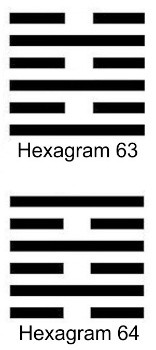 achievement is just ahead. It’s interesting that the ancient sages ended with it, rather than a sense of finality.
Our Western medicine does not understand disease this way. The modern culture, in which medicine and science are just parts, lacks an overarching frame of reference. We are perfecting the question of how but largely ignoring the question of why. That the body could have energies that are seeking development, or transformation, and failing that transformation morph into pathology is a notion that is commonly sensed and yet has no conceptual footing in the conventional system of medicine. Instead, our medicine, though technically superior, seems without fundamental priorities.
In ancient China, all of culture was organized under one philosophy. The goal was the understanding of universal principles. The transformations of Yin and Yang were laid out and became the basis for medicine, political thought, even cooking. All phenomena were understood as layers and relationships of initiating or resisting, forcing or collapsing, supporting or checking. These concepts, so rooted in the patterns of nature, were to be felt as living relationships. This is how the ancient doctor approached health. Or how the ancient magistrate administered his office. Or how the martial artist disciplined his body.
I was lucky to have encountered the Gurdjieff teaching before studying Chinese medicine. Gurdjieff was emphatic: contemporary people cannot see reality and our mode of perception has worsened. For me, this critique was an entry point into the possibility of a pre-modern mode of thinking. Later, when I was teaching Chinese medicine, I wanted to explain the importance of letting go of our habit of labeling incoming experiences. It was hard to get students to understand that they were being asked to see, not think. Ted Kaptchuk, author of The Web That Has No Weaver: Understanding Chinese Medicine, once said that Chinese medicine is like appreciating traditional landscape painting—you take in the whole scene and absorb the relationships without so much mental analysis.
But this new apprehension, a prioritizing of seeing the whole, is, in itself, not enough. Perhaps the hardest thing to relate to people who want to study genuine Taichi, or who want to naturally heal a complex illness, or who wish to really enter the Work, is that beyond a certain point, these undertakings require more than we are initially prepared to imagine. We may find that we are impossibly naive about how we must work for transformation.
A senior member of the Work seemed surprised when I told him that I was never invited into the inner fold of this Taichi school to which I devoted nearly two decades of my early adulthood. He was surprised, it seemed, that I did not measure up to the standards of what would be considered an “inside student,” a student who works hard enough to be given special instruction reserved for the very few. I recently read the notes of someone who did become an “indoor student,” and later a true master in his own right. He persevered, for up to 10 hours a day for decades—working on practices much more difficult than the positions I could barely maintain for five or ten minutes. I can say with certainty that Gurdjieff’s descriptions of the “way of the fakir” are actually not exaggerations. There really are extremes of human will that produce unnatural results.
Returning to our Chinese doctor as an example: He still has a fundamental choice during treatment—to simply release pent up energy, which will provide temporary and symptomatic relief, or to somehow help bring about a transmutation. The second way is much more difficult; it requires a sustained shift—meaning a substantial realization.
The Chinese have an everyday expression: the phrase Chi-ku, 吃苦, meaning “eat bitterness.” It has been used to encourage children to study hard, or to bear years of back-breaking labor on behalf of a family an ocean away, or to describe the politically persecuted in an unjust system. The full expression is “eating bitter is good fortune.”
Gurdjieff also placed struggle and intentional suffering at the core of his teaching. Somehow, paradoxically, an emphasis on suffering, if nuanced, brings some surprising formulations. It can bring, for example, a faith that in the disease is also the cure. Acupuncture, as an example, artfully places the patient back in him- or herself, and healing results from this.
Returning to the young man on the table whom we began with: Without a doubt, he could have been—and surely still is—me. He is discouraged that his attention is always faltering, his body’s energies are always doing what they prefer, and his psyche is undisciplined and weak. Yet in “not achieving,” by learning to stand between, in a position that is both strong and relaxed, he eventually learns that subtle transformations can occur according to the laws of healing. Having tasted yes and no, a potential reengagement is always really close. The crucible can be restarted with whatever is placed into it. The famous Wuwei—“non-action,” or “effortless action”—implies that there is very little “to do” to enter this crucial step.
Critically, the young man learns that Wuwei does not mean not trying anything and just waiting for things to be easy. Wuwei does not imply that in transformation there is no suffering and that everything is achieved without opposing forces. The meaning of Wuwei must be paired with the understanding of ming men, because together they imply that there is very little “to do” to enter the crucible. Life itself orders us to follow it. □
Jeff Matrician, a member of the Gurdjieff Society of Massachusetts since 2000, has maintained a private practice in Watertown since graduating from the New England School of Acupuncture in 2002. After graduating, he taught acupuncture for about a decade at his alma mater and also established a practice at University Health Services at Harvard University. Jeff continues to study and teach Taichi at various locations around Boston.